
Western Riding Basics for Your First Desert Ride
A good first horseback ride does not start when the horse takes its first step. It starts at the mounting block, when a wrangler helps you settle into the saddle, explains how to hold the reins, and reminds you to breathe. Western riding basics are less about looking like an expert and more about feeling calm, communicating clearly, and letting a well-trained horse do the job it knows.
For many Arizona visitors and local families, a guided desert ride is their first time in the saddle. That is exactly what guided experiences are designed for. You do not need years of lessons to enjoy the quiet of the trail, the wide desert views, or the stories connected to the land. A little preparation simply helps you arrive ready to relax and enjoy the experience.
Western Riding Basics Start With the Right Mindset
Western riding is built around a practical, balanced seat and clear, uncomplicated cues. On a guided trail ride, your wrangler will match you with a horse suited to your experience level and walk you through what that horse responds to. Listen closely, ask questions, and remember that a relaxed rider is easier for a horse to understand.
Your horse is not a vehicle. It is a living partner with its own attention, sensitivity, and training. Sudden movements, loud squeals, or pulling hard on the reins can make communication less clear. Keep your body quiet, your hands soft, and your focus on the trail ahead.
There is no prize for pretending to be more experienced than you are. Tell your wrangler if you feel nervous, have an old injury, or have never ridden before. That information helps the team give you better guidance from the start.
Dress for the Saddle and the Desert
Comfortable clothing makes a real difference. Choose long pants that allow easy movement, plus closed-toe shoes with a defined heel. A low-heeled boot is ideal because it helps keep your foot properly positioned in the stirrup. Avoid loose sandals, bulky footwear, or anything that can slip easily.
Arizona weather can shift quickly between a cool morning and a warm afternoon. Lightweight layers, sunscreen, sunglasses, and a hat that fits securely can make the day more enjoyable. If a helmet is offered or required for your ride, wear it as directed. Safety gear is not a statement about skill. It is part of being prepared for an outdoor activity.
Leave dangling scarves, oversized bags, and loose items behind. Anything that flaps, swings, or falls can distract you and your horse. Bring only what you can carry securely or store with the staff.
Getting On and Finding Your Balance
Mounting is one of the moments where a wrangler’s help matters most. Follow their instructions, use the mounting block if provided, and avoid pulling on the saddle horn as you step up. The horn is there to support the saddle’s design, not to carry your full weight.
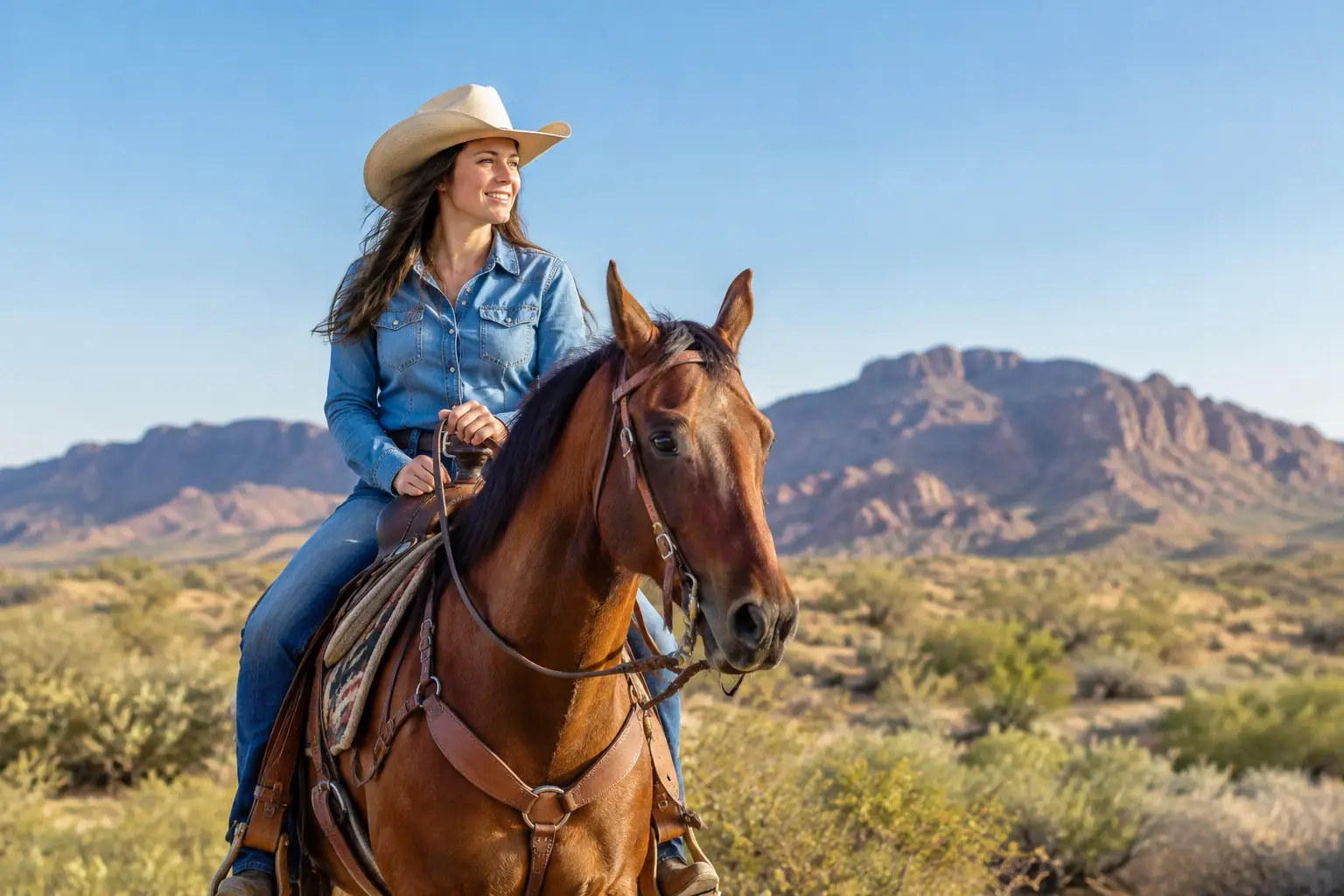
Once seated, sit deep in the saddle with your shoulders relaxed and your eyes up. Let your legs hang naturally along the horse’s sides, with the ball of each foot resting in the stirrup. Your heels should be slightly lower than your toes, not forced downward. This gives you a stable foundation without gripping tightly.
New riders often try to hold on with their knees. That can make the body stiff and may send mixed signals to the horse. Instead, think of lengthening your leg and allowing your hips to move with the horse’s walk. Your seat should feel secure but flexible, like you are moving with the rhythm rather than bracing against it.
Hold the Reins With a Light, Steady Feel
Your wrangler will show you how they want you to hold the reins, as riding methods can vary slightly by horse and route. In general, keep your hands low, in front of the saddle, and close enough together that you can give a simple direction without overcorrecting.
The most common beginner mistake is pulling backward when feeling uncertain. A horse feels much more than a rider may realize, so a small movement is usually enough. To ask for a turn, look where you want to go, shift your attention in that direction, and use the cue your wrangler has demonstrated. To slow or stop, sit tall, exhale, and apply a gentle, even rein cue as instructed.
Avoid wrapping reins around your hand or wrist. If you lose your grip, let them go rather than trying to hold on in an unsafe way. Your guide will explain what to do if that happens, and well-managed trail horses are accustomed to patient, beginner-friendly riding.
Let Your Legs Support the Conversation
Your legs help communicate too, but they do not need to be constantly active. Keep them relaxed against your horse’s sides. When your wrangler explains how to ask your horse to move forward, use the lightest cue that works. Repeated kicking can confuse or annoy a horse, especially when the horse is already doing what is being asked.
If your horse pauses to look at something or reaches toward a tempting desert plant, do not panic. Keep your seat centered and follow the guidance you were given. Your wrangler is watching the group, the horses, and the trail conditions. A calm correction is far more effective than a sudden reaction.
It also helps to avoid comparing your horse with someone else’s. One horse may walk with a longer stride, another may be more curious, and another may prefer a little personal space. Those differences are normal. The goal is not to control every detail. It is to build a comfortable partnership for the ride.
Trail Etiquette Keeps the Ride Enjoyable
A guided ride is a shared experience. The best moments often happen when everyone gives the horses enough room, listens to the wranglers, and takes in the scenery together. KOLI Equestrian Center is known for offering more space and social connection than a rigid, packed line, but spacing still matters for every horse’s comfort.
Keep a respectful distance from the horse in front of you unless your guide says otherwise. Horses have different preferences about their space, and crowding can lead to ears pinned back or a reminder from the horse to step away. If your horse slows down, resist the urge to push closely behind another rider. Let your wrangler know if you need help.
Speak at a normal volume, but save sudden shouting for a real emergency. Never feed a trail horse without permission, and do not reach toward another rider’s horse. Even friendly horses need consistent boundaries while they are working.
Photos are part of the fun, especially against a Sonoran Desert backdrop, but take them only when it is safe to do so. Keep a secure hold on the reins, ask before using your phone, and do not turn your whole body around for a picture while your horse is moving. The best photo is not worth losing your balance.
Learn From the Land, Not Just the Saddle
A desert horseback ride can be more than an outdoor activity. The landscape holds stories in its plants, waterways, mountain views, and long-standing cultural connections. When your wrangler shares knowledge about the area and its Native American heritage, listen with the same care you give your riding instruction.
Respect for the land is part of respect for the experience. Stay on the designated route, leave plants and artifacts where they are, and pack out what you bring in. The desert can look open and untouched, yet it is a living environment shaped by generations of people, wildlife, and seasonal change.
For first-time riders, that bigger sense of place can take pressure off the idea of “performing” in the saddle. You are there to be present: to feel the horse’s steady movement, notice the quiet between conversations, and see Arizona from a perspective that a car window cannot offer.
What to Do if You Feel Nervous
Nerves are common, and they do not mean you are doing anything wrong. If your hands feel tight or your breathing gets shallow, focus on a simple reset: look ahead, lower your shoulders, take a slow breath, and soften your fingers around the reins. Tell your wrangler how you are feeling. Experienced guides would much rather answer a question early than have you stay uncomfortable.
Do not watch every step your horse takes. Looking down can pull your balance forward and make you feel less secure. Keep your eyes on the trail several feet ahead, trust your horse’s footing, and let the saddle support you.
The most memorable rides are rarely the ones where everything feels perfectly familiar. They are the ones where a first-time rider realizes, somewhere between the desert breeze and the rhythm of the trail, that confidence can begin with simply taking the next calm step.